Nitration of benzene produces nitrobenzene, an important compound that is used as a solvent and an intermediate in the manufacturing of organic compounds. Nitrobenzene is typically produced in industry by using liquid phase nitration of benzene, where the process uses nitric and sulfuric acids in a highly exothermic reaction. In the process, sulfuric acid needs regeneration, which requires high energy consumption and also it is problematic from environment point of view. On the other hand, vapor phase nitration (Fig. 1) is a cleaner process without sufuric acid waste, eliminating the need to separate the reaction products from the catalyst.
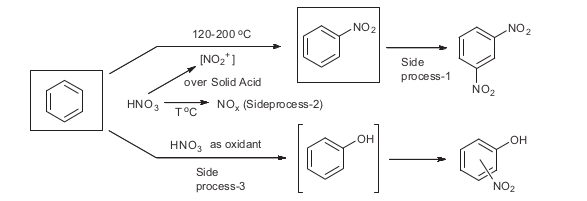
In this project, I assisted Dr. P. T. Patil and Dr. M. K. Dongre of National Chemical Laboratory (NCL), Pune, India, in conducting the experiments. The undergraduate thesis included analysis of the lab-scale reaction kinetics and design of industry-scale process for the vapor-phase production of nitrobenzene.
 Vilas Shinde