The cement manufacturing process consists of multiphysics flow including particle laden gas flow, combustion, and heat transfer. Furthermore, the Reynolds numbers involved are typically much higher than tractable for high-fidelity CFD simulation techniques such as large eddy simulation (LES). Thus, Reynolds averaged Navier-Stokes (RANS) approach of modeling turbulence for CFD simulations is the industry standard, providing reasonable insights into the flow physics and engineering solutions.
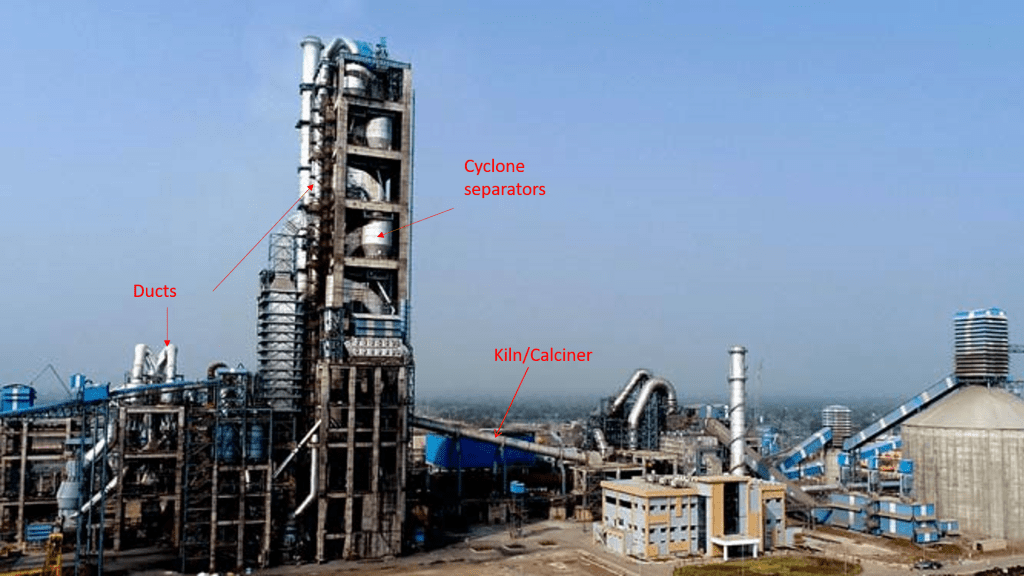
In cement industry, CFD can be useful in the design of large ducts, cyclone separators, kiln/calciner, baghouse filter, electro-static precipitator, gas conditioning tower, and coal mill (see Fig. 1). In particular, these process equipments can have large design factor and may operate at off-design conditions, leading to their inefficient operation. Thus, CFD plays a major role in troubleshooting and design improvements for these equipments.
Cyclone Separators
The cement raw material is fed to the kiln via a preheated unit, where it is mixed and separated with the kiln exhaust gases in a series of ducts and cyclone separators. Some of the challenges in the design of cyclone separators include high pressure drop, low separation efficiency and surface erosion.
To simulate this multiphysics flow, in general, we use full Reynolds stress model, Speziale-Sarkar-Gatski (SSG), and establish a turbulent mean flow field, clearly identifying the regions of circulations. In the second stage of calculation, Lagrangian particle tracking is performed to evaluate the separation efficiency and erosion patterns of the cyclone separator. Some of the modifications in cyclone design were to guide the slow regions to reduce pressure drop and improve separation efficiency, resulting is a substantial power saving and better thermal efficiency.
Gas Conditioning Tower
Gas conditioning tower (GCT) is placed downstream of the cyclone separators in order to condition the exhaust gases for appropriate temperature and moisture percentage, suitable for electro-static precipitators situated further downstream in the process. The exhaust gases typically enter the GCT from top in a narrow duct compared to the GCT diameter. This sudden expansion in cross sectional area as well as inlet duct bends lead to a highly non-uniform flow entering the GCT. A flow straightener is considered before water sprays, which maintain the gases at appropriate conditions.
Flow uniformity and residence time are of primary importance for an effective GCT. CFD analysis has significantly improved the design considerations for GCT in terms of the inlet ducting, flow residence time, and uniform temperature and mixing profiles. In addition to the particle laded gas flow, the GCT introduces water droplets that evaporate, resulting in a fairly complex multiphysics to model.
Baghouse Filter
Baghouse filters are commonplace in process industries as an air pollution control device that, in general, separates solid particulates from effluent gases. They are known for their robust performance compared to electrostatic precipitators for varying inflow configurations and high efficiency; however, inlet temperature, pressure drop, and gas flow rates tend to affect their performance.
Similar to gas conditioning towers, the flow uniformity is examined by means of CFD simulations, in order to avoid hot spots and damaging of the filter bags.
 Vilas Shinde