Understanding the role of pressure fluctuations in wall turbulence is of significant practical interests. In incompressible flows, due to elliptic nature of the Navier-Stokes equations, the pressure at a location is affected by the momentum fluctuations in the entire domain. However, the effects in the near-location (wall) region are stronger, and can be attributed to coherent flow structures. Two-point correlations provide a simple means to examine this spatial coherence, yielding a better understanding of flow spatial structures useful for turbulence modeling.
In this work, we examine the two-point turbulent correlations subjected to the mean pressure gradient, including the effect of surface curvatures. We use the existing direct numerical simulation (DNS) database to extract two-point correlations between the turbulent wall pressure-pressure and wall pressure-velocity correlations at selected locations, as shown in Fig.1.
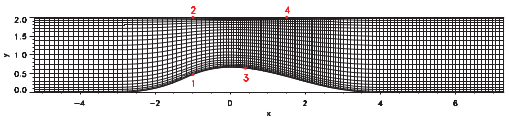
In addition to the mean favorable and adverse pressure gradients, the surface curvatures at the selected wall locations (Fig.1) are found to have considerable effect on the two-point correlations, as displayed in Fig.2, where the subfigures (a), (b), (c), and (d) correspond to plane channel flow, flat wall with favorable mean pressure, lower curved wall with favorable mean pressure, and flat wall with adverse mean pressure, respectively.
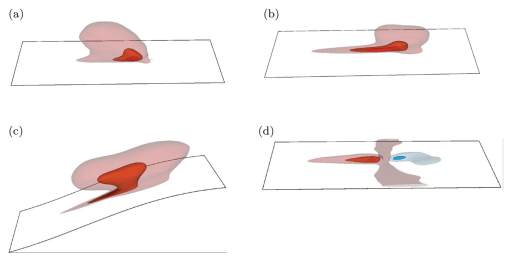
Overall, the results show that these pressure-pressure and pressure-velocity correlations are not only sensitive to the local pressure gradient and wall curvature, but also to the pressure gradient history.
 Vilas Shinde