Digital Filtering Technique
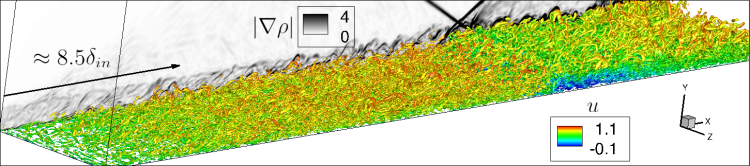
Digital Filtering (DF) is an efficient method to generate the inflow turbulence, which is an important parameter that can affect the physics of interest. In most of our supersonic LES simulations, we employ the digital filter procedure that is originally proposed by Klein et al. (2003), and later improved by Xu et al. (2003). The method limits the required filtering operation to a two-dimensional inflow plane while using a temporal correlation function to avoid three-dimensional filtering. Furthermore, the spatial auto-correlations are assumed to be exponential rather than Gaussian, which leads to better correlations for the dominant flow structures. The streamwise mean velocity and Reynolds stresses for the digital filtering are typically obtained from the precursor direct numerical simulation (DNS). In general, the length scales are normalized by the inflow boundary layer thickness, and thus the DNS statistics can be directly used without any scaling of the profiles. The procedure requires about 8 ∼ 12 inflow boundary layer thickness downstream of the inlet to establish the turbulent boundary layer. Figure 1 displays an application of the digital filtering technique, where the inflow is at Mach 2.7, indicating the establishment of about 8.5 inflow boundary layer thickness.
 Vilas Shinde