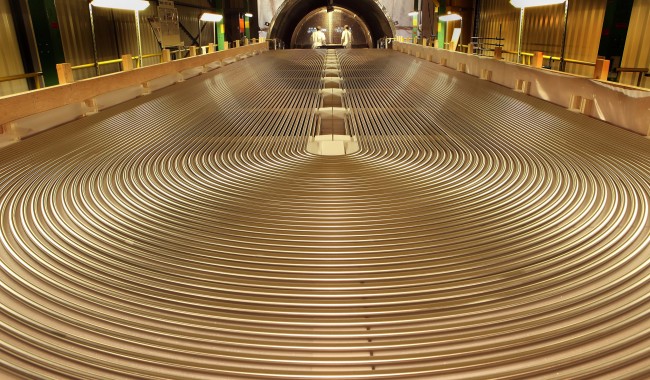
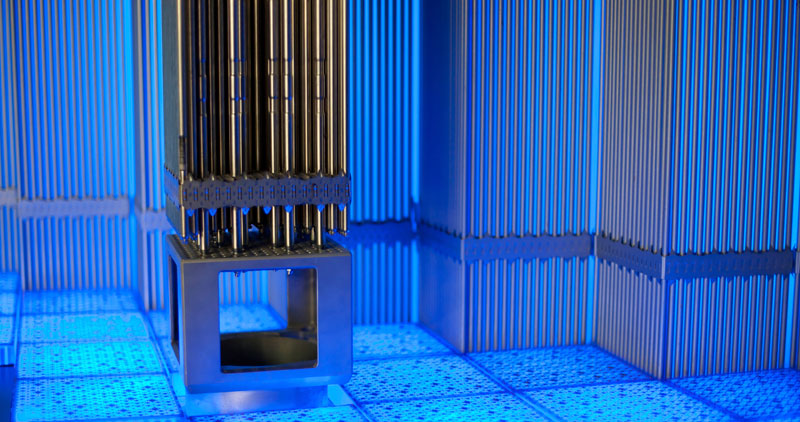
The steam generator and reactor core of a nuclear power plant comprise a large number of small tubular structures with high interstitial velocities, leading to high Reynolds numbers, for instance, Figure 1 shows the internal view of the two process equipments. High-fidelity CFD simulation of the entire steam generator or reactor core is not feasible for the available computational resources. To investigate a particular phenomenon such as the fluidelastic vibrations, one would resort to small prototypes accounting for the geometrical effects. Homogenization/macroscopic modeling for such large systems enables us to simulate the entire process equipment with reasonable accuracy from the engineering perspective.
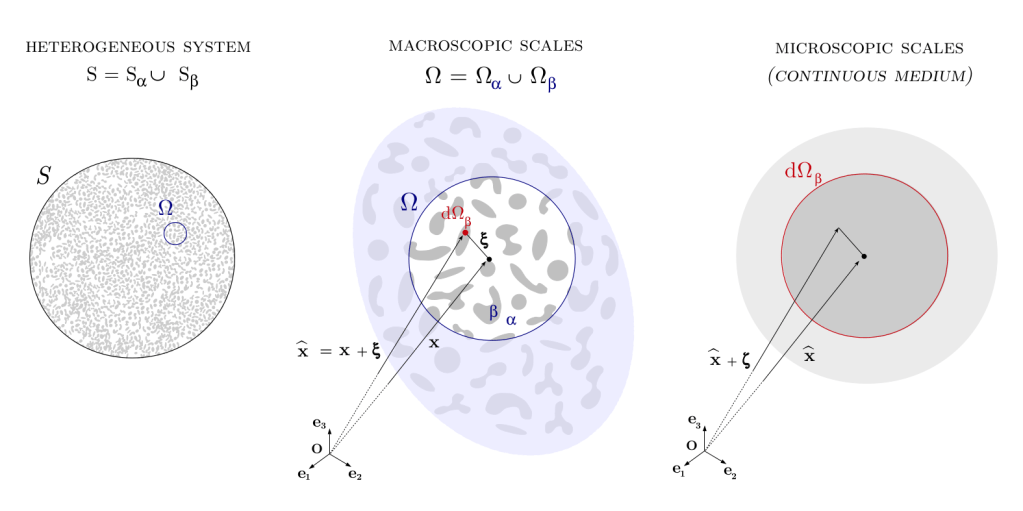
In the present work, we use the theory of mixture to describe the dynamic behavior of cylinders featuring a vibrating response to external loading strongly dependent on surrounding viscous flow. From mass conservation and momentum balance of a given volume of mixture, one derives a set of coupled equations linking space-averaged solid displacement, fluid velocity and pressure fields. The schematic of Fig. 2 illustrates the modeling approach. Fluid-dynamic load acting on a vibrating cylinder wall is written as a function of both fluid and solid space-averaged kinematics fields. Finally a macroscopic model is proposed and evaluated on a configuration involving the vibrating response of an array made up of hundreds of cylinders, subjected to external hydrodynamical load, as shown in Fig.3.
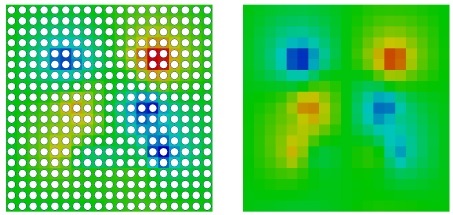
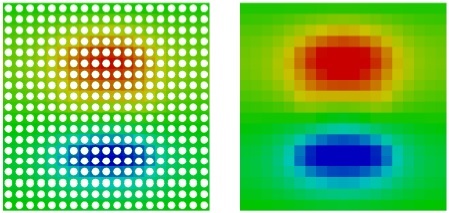
within a square cylinder arrangement in a fluid at rest
 Vilas Shinde