Shock wave boundary layer interaction (SBLI) exhibits low frequency unsteadiness, which can interact with structural modes, giving rise to detrimental fluid-structure interactions. To investigate the physics of these interactions, we perform high-fidelity simulations of transitional and turbulent SBLI over flexible surfaces.
Transitional SBLI over flexible panel
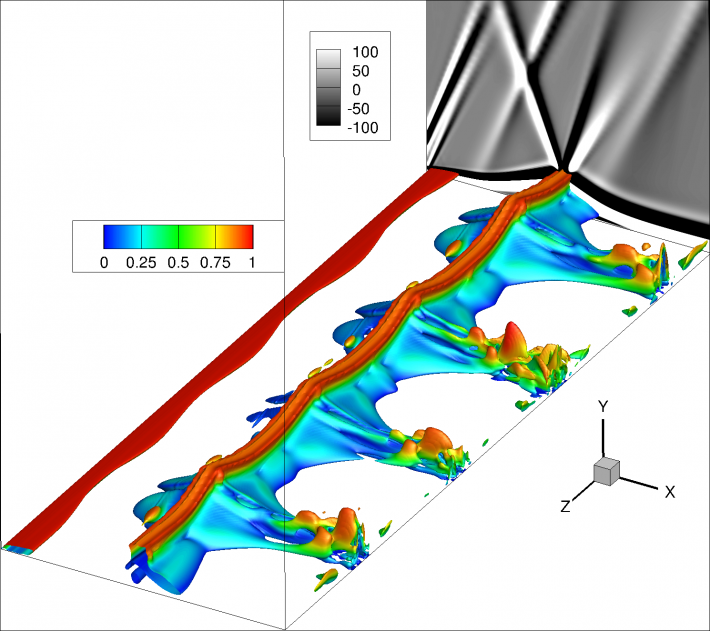
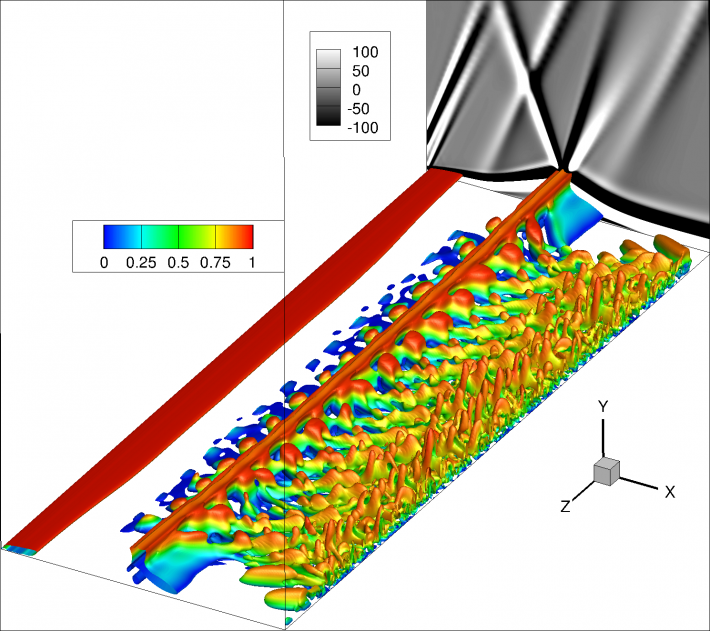
We investigate a full 3-D transitional SBLI over a flexible panel by performing direct numerical simulations (DNS). A nominally 2-D laminar boundary layer at Mach number 2 interacts with an oblique shock wave with the shock angle of 35 deg and shock strength of 1.8 (p3/p1) in the presence of flexible panel. Simulations are performed for a range of Reynolds numbers (based on panel length), and the coupling between fluid and structure is explored. The flow transition to turbulence occurs at a lower Reynolds number for the flexible panel (Re≈40000) compared to the rigid panel (Re≈70000) simulation. This is manifested through the appearance of unsteadiness and three-dimensionality. The transitional SWBLI exhibits the Görtler instability and low/high frequency unsteadiness, which are characterized interms of Görtler number and wall pressure power spectral density respectively for both the flexible and rigid panels. The principal Reynolds stresses are significantly modified due to the flexible panel, particularly in the near wall region, resulting in overall increased level of turbulence and skin friction coefficient.
Turbulent SBLI over flexible panel
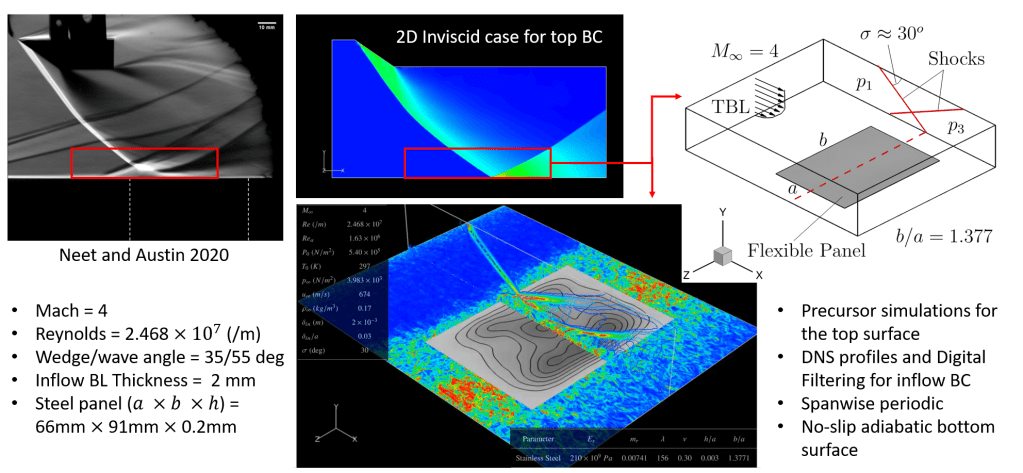
Shock wave turbulent boundary layer interaction (SBLI) over a flexible panel is investigated by performing large eddy simulations (LES). The supersonic flow is at Mach 4 and unit Reynolds number of 2.375 × 10 7 (/m). The incident oblique shock with the shock strength p 3 /p 1 ≈ 8.5 and shock angle σ ≈ 30 deg impinges near the mid-chord length of the panel. The panel aspect ratio and thickness, normalized by its length a, are b/a = 1.377 and h/a = 0.003 respectively. At first, we examine the baseline STBLI on a rigid flat surface, where a strong adverse pressure gradient due to the shock impingement leads to a large flow separation (L se p ≈ 23δ in ), giving rise to the characteristic low-frequency unsteadiness of the separation bubble. Secondly, we inspect the fully coupled fluid-structure interaction (FSI) between the STBLI and flexible panel, where the interplay exhibits sustained limit cycle oscillations (LCO). The panel’s response and flow physics are elucidated by performing modal analyses, in terms of the proper orthogonal decomposition (POD) and dynamic mode decomposition (DMD). In this effort, we also present our recently developed FSI solver framework, where we externally couple the standalone finite difference flow and finite element structural solvers.
 Vilas Shinde