Control of Transitional SBLI
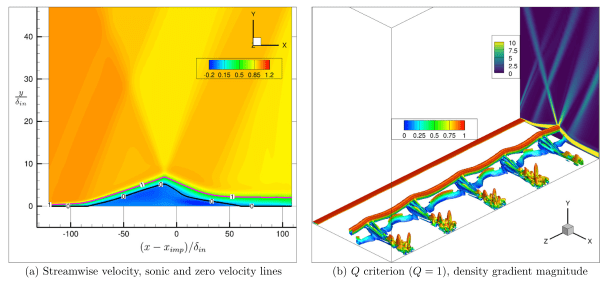
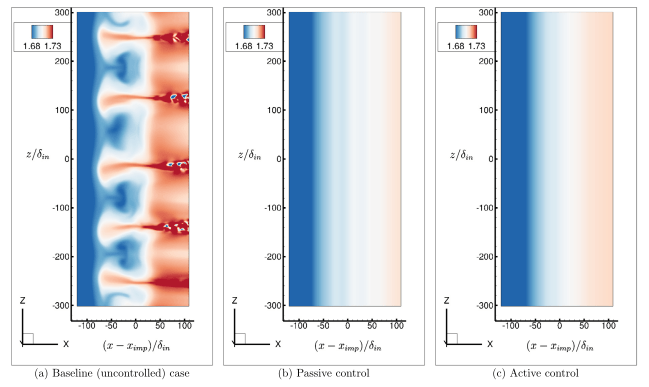
The potential of surface morphing techniques, including passive shock control bumps (SCB) and active surface morphing, is explored to control transitional shock wave boundary layer interactions (SWBLI). In addition to reducing the size of the separation bubble, a key objective is to mitigate the low-frequency unsteadiness that can cause detrimental structural response. To this end, three-dimensional flow simulations are performed using direct numerical simulations (DNS) at Mach 2 and Reynolds number based on inflow boundary layer thickness Re δ in = 996. An incident oblique shock of angle σ = 35 deg and strength p 2 / p 1 = 1 . 4 impinges on a laminar boundary layer that evolves from a Blasius profile. The resulting boundary layer separation leads to transition and a Görtler-like instability is observed; the nominally two-dimensional and steady flow becomes three- dimensional and unsteady. The goal of this work is to develop a surface modification method to mitigate separation and low-frequency unsteadiness, which can trigger structural response and flow distortion. An aero-structural solver framework is developed and employed to examine both passive SCB and active surface morphing. To avoid unrealistic structural deformation in the transient or final states, the structural integrity is concurrently monitored so that the intermediate morphing solutions are restricted to achievable elastic deformations. The results indicate that transitional SWBLI can be controlled in this manner, to essentially inhibit transition and thus eliminate the separation and unsteadiness associated with the Görtler-like vortices. The mechanism modulates sharp increases in surface pressure at separation and shock-impingement locations encountered in uncontrolled SWBLI and results a lower specific entropy rise.
Control of Turbulent SBLI
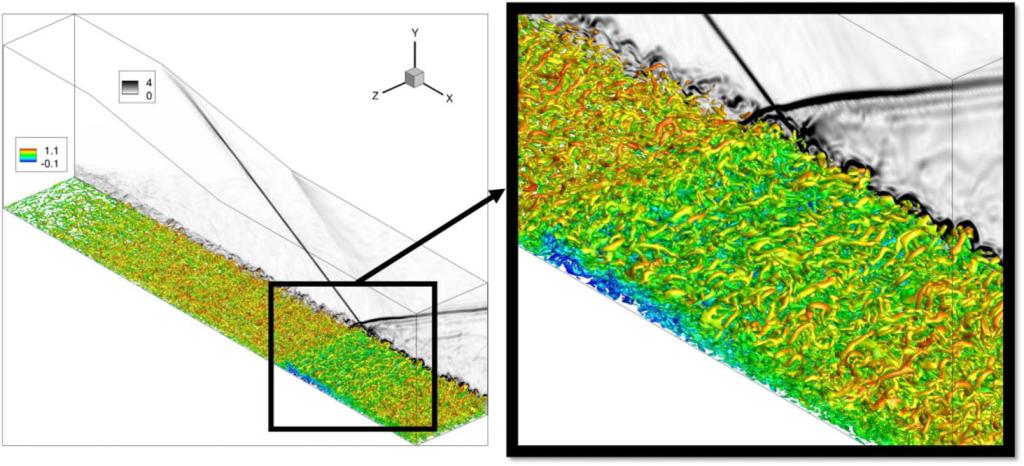
Separated flows arising due to shock wave turbulent boundary layer interactions can cause problematic low frequency unsteadiness with potentially severe structural response. High-fidelity large eddy simulations are employed to examine surface morphing as a way to reduce the size of the separation region, and thus favorably alter the unsteadiness characteristics. The configuration considers a turbulent Mach 2.7 flow at Reynolds number Re = 54600, subjected to an impinging shock system of pressure ratio p 3 /p 1 = 3, which results in separation and the presence of structurally relevant low-frequency unsteadiness. The control surface, centered about the shock impingement location and extending over the separation region, is allowed to deform under material property-based realizability constraints, until an asymptotic state is achieved. The criterion for deformation uses a measure proportional to the directional surface shear-stress. At asymptotic state, the deformed surface reveals a shape consistent with aero-structural optimization and a maximum height of 0.32δ in . Control mitigates the sharp initial pressure gradient of the uncontrolled flow to delay and reduce separation extent (by 50%), with diminution of low frequency content and turbulent kinetic energy. Modal decomposition highlights these effects in the energy content of the prominent modes. Morphing may thus provide a means to adjust the local surface deflection in a manner that reduces some of the problems associated with turbulent separation.

 Vilas Shinde